Understanding House Edge
Your complete guide to house edge and which games have the best oddsNo matter which game you are playing, the odds are always set in the casino's favour. Read our guide on understanding house edge to find out more.
What is a Casino House Edge
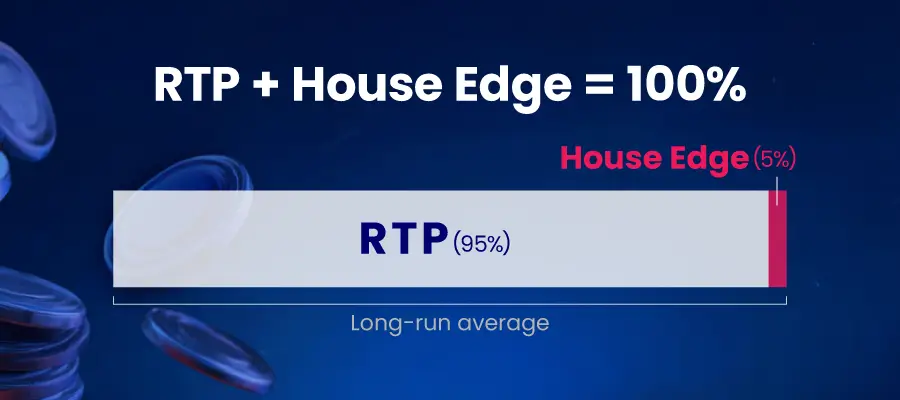
Casino house-edge is the casino’s built-in mathematical advantage, which plays out over the long run. House edge reflects the amount of money that a top online casino can expect to win over the long run, which would comprise many thousands of hands or spins, or tosses of dice.
For example, if the casino has a house edge of 5%, this means that for every £100 wagered, the casino will earn £5 over the long run.
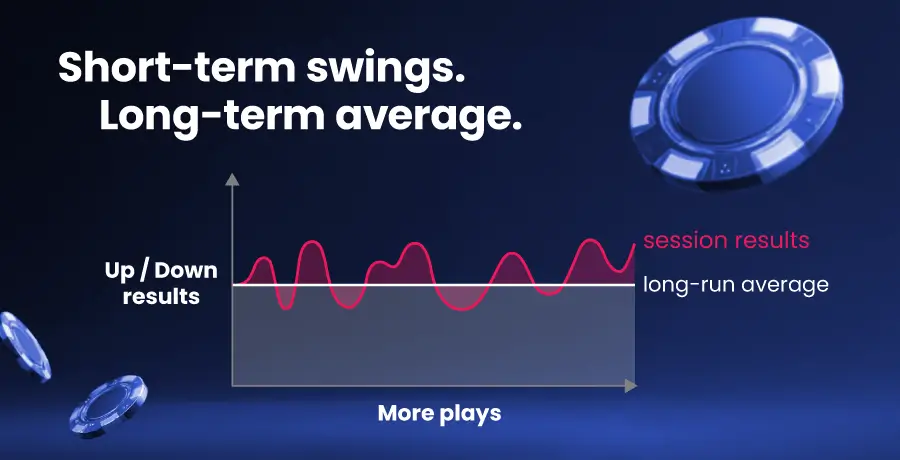
A straight line would not represent the casino’s house edge. In the short run, anything can happen; the casino’s house edge can rise and fall dramatically.
This is called variance, and it is what makes casino gambling fun.
You cannot predict the outcome of a casino game in the short run. Over a brief period, a casino can win or lose any percentage of the money put in play.
However, over the long run, this will work out to be 5% that goes to the casino, with the remaining 95% going back to the players. The percentage that goes back to players is known as RTP or Return to Player.
How House Edge Works in Online Casino Games
House edge is based on probability models. In games like blackjack, craps, and roulette, those are longstanding calculations. They are the same for online casinos and online poker sites as they are for brick-and-mortar casinos.
In newly introduced electronic games – such as recently launched slot machines and video poker variations – the house edge is calculated through millions of game plays via computer simulations.
Mathematical models are used to adjust the game and its odds, allowing the house to maintain its desired profit over the long run.
Casino games are games of chance, and outcomes are random and cannot be predicted in the short term. Every game also has a built-in house edge, meaning most players lose money over time.
In regulated casinos, you can usually find the rules plus the game’s RTP/house edge in the game info screen before you play. Because regulations and RTP vary by title and version, your experience can differ from game to game, and bonus wagering contributions may also vary between slots, table games, and live casino.
CASINO GAMES DISCLAIMER
Licensed games are independently tested for fairness (RNG and maths) by specialist third-party labs. Gambling is entertainment. To reduce risks, play only at a licensed casino and set limits before you start.
How Game Providers Calculate House Edge
While some of the house edge calculations are performed in-house by the game manufacturer, this is not sufficient to provide final confirmation of the house edge.
Third-party testing companies, such as eCOGRA and iTech Labs, also run programs to calculate house edge. Independent testing adds an extra layer of confidence, but RTP settings can vary by game version, provider, and casino.
By being able to see details of house edge and RTP – visible on a game’s information screen or provider documentation – players can be confident about which games are best for them. The goal is to provide a level of transparency that keeps players informed and at ease.
Why Understanding House Edge Helps UK Players Make Better Choices
In many walks of life, knowledge is power. This extends to casino gambling.
Knowing the house edge on a casino game is essential because it reveals the financial advantage the house has over players. It allows gamblers to play games with the risk profile that best suits them.
For example, in the case of a game with a 5% house edge, over the long run, gamblers will lose £5 for every £100 that they wager. In a game with a 10% house edge, over the long run, gamblers will lose 10% of every £100 wagered. This amounts to a long-run expectation of £10 lost for every £100 wagered.
A lower house edge generally means increased value for gamblers over the long run. Nevertheless, it’s important to note that a lower house edge does not guarantee winning sessions. This is due to volatility, which is a long-term indication of how often a player will win.
The point of there being no guarantee of short-term returns – for the player or the house – was driven home in a paper published by the International Journal of Contemporary Hospitality Management.
The people behind this study placed two similar slot machines in the same casino. One had a larger house edge, while the other had a smaller one. In the study, which lasted 180 days, the casino’s realized house edge was pretty much the same on both machines.
Over the long run, it would not have been the case. And the outcome, over just 180 days, could have gone either way for the players and the house, illustrating what short-term outcomes can look like.
Considering all this, it is essential to stay in control of what you are doing when it comes to gambling in casinos. Remember to set win and loss limits and to stop playing once those limits are reached.
Familiarity with RTP and the realities of variance allows you to set realistic expectations regarding possible outcomes, which, of course, will vary significantly over the course of various gambling sessions.
Knowing House-Edge Gets You Only So Far
While it’s beneficial to be aware of the house edge and RTP, there is no guaranteed outcome in the short term. Playing games with a low house edge and high RTP provides good theoretical value. However, the realized value, particularly in the short term, has a significant component of luck.
FINANCIAL RISK WARNING
Gambling involves real money and a risk of financial loss. Every casino game has a built-in house edge, meaning that most players will lose over time. Even if you choose games with a lower house edge or a higher RTP, the results in the short term can swing wildly due to luck. Only gamble what you can afford to lose, and set strict deposit, loss, and time limits before you start.
Casino Games with the Lowest House Edge
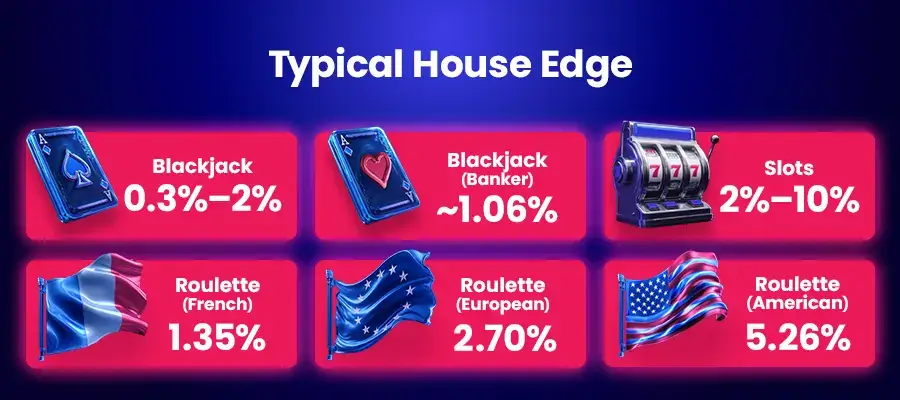
Different games provide different house edges. It’s worth keeping this in mind when selecting the game you want to play. Since each game is unique – say, blackjack as compared to roulette – it makes sense that the house edges would be unique as well.
For example, blackjack can have a house edge as low as 0.3% when there are optimal rules (see the comparison table below), and you play with perfect basic strategy, without ever veering away from it. This means that, over the long run, for every £100 wagered, the house will retain only 30p. However, that is a theoretical number, based on the long run of playing. In the short run, over the course of a single session, wins and losses can deviate significantly from that .3% number.
Other games with low house edges, over the long run of play, include European roulette, baccarat when wagering on the banker, and some video poker games.
That said, the house edge on the same game can vary from one game provider to the next. This can be based on pay tables and rules. For example, a blackjack game that allows the dealer to hit soft 17 increases the house edge by approximately 0.2%.
While the number sounds small, over time it can add up.
For skill-based games, such as blackjack, the house edge is reduced only when you employ perfect basic strategy. For games like craps, the house edge goes down significantly if you only make passline bets and take maximum odds once a point is established.
Here is a comparison table that shows house edges for games that offer desirable RTP.
| Casino Game | Typical House Edge | What Affects the House Edge? |
|---|---|---|
| Blackjack | 0.3% – 2% (with optimal strategy) | Number of decks, dealer hitting/standing on soft 17, doubling/splitting rules, player strategy |
| Video Poker | 0.5% – 5% (strategy-dependent) | Pay-table structure, game variant (e.g., Jacks or Better vs Deuces Wild), and optimal strategy use |
| Baccarat | Banker: ~1.06% Player: ~1.24% | Commission rules, Tie payout ratio |
| Slots | 2% – 10% (varies widely) | RTP value, game provider, volatility, bonus features |
| Roulette | European: 2.70% French: 1.35% (La Partage) American: 5.26% | Number of zeros, special rules (La Partage, En Prison) |
| Craps | Pass/Don’t Pass: ~1.36% Other bets: 2% – 16%+ | Bet type, table variant rules |
Blackjack House Edge
Blackjack is one of the most popular games in the casino, and that is for good reason. Players like being in control of their actions, deciding when to hit, stand, and double down.
It also helps that blackjack offers a low house edge, which varies from 0.3% to 2% when the game is played with unwavering basic strategy (meaning that you always split Aces, for example).
The casino’s rules determine the house edge of blackjack. And some rules reduce the house edge. For example, it is best to find games where the dealer stands on soft 17, players can double down with any two cards against any card that the dealer is showing, and the game is played with six decks rather than eight. Fewer decks decrease the house edge.
Most importantly, to keep the house edge low when playing blackjack, always follow basic strategy.
Video Poker House Edge
While the video-poker house edge can be appealingly low, not all video poker games are created equally.
Depending on the game you play, the house edge can go from 0.5% to 5% over the long run. Sometimes the difference in house edge is minor. Jacks or Better, for example, has a house edge of around 0.5%; Deuces Wild has a house edge closer to 0.75%.
In terms of that last point, remember that different casinos offer different pay tables for the same game.
One casino may pay more for a whole house than other casinos do. Playing the version of a game with the most generous payout will increase long-term, theoretical RTP.
Baccarat House Edge
Although movies from the James Bond franchise portray baccarat as a game for the rich and famous, the reality is that it’s an excellent game for everyone. Players in the know, who bet on banker, can experience one of the lowest house edges in the casino.
When playing baccarat, three distinct bets can be made: the banker, the player, and the tie. The banker is betting that the banker will get closest to 9 from the cards dealt (which is the object of baccarat). Putting your money on a player is betting that the player will get closest to 9. And tie, obviously, is betting that the two sides will tie from the cards that are dealt.
The house edge on banker bets is approximately 1.06%; the house edge on player bets is about 1.24%; the house edge on tie bets is a stunning 14.36%. Some people can’t resist the 8% payoff that a winning tie bet will bring, and they hope for short-term profits.
But, in the long run, which all house edge and RTP numbers are based on, the tie bet produces an unusually advantageous edge for the house.
Roulette House Edge
When it comes to the house edge at roulette, there is no contest between American roulette and European roulette.
The European roulette wheel has one zero. The American roulette wheel has a zero and a double zero. That introduces an additional variable into the mix of possibilities, and the house edge increases accordingly.
That one extra number is consequential in the long run. The house edge at European roulette, over the course of the long run, is 2.7%. For American roulette – primarily due to the double zero – the house edge is 5.26%.
Along with all that, there is a third option: French roulette, with one of two special rules, La Partage and En Prison. Each comes with the lowest house edge of all, at just 1.35%.
La Partage deems that any losing even-money bet – wagering on black or red – gets split 50/50 between the player and the house. Hence, if you bet £100 on red and the ball lands on black, you lose only £50.
When games feature the En Prison rule, any losing even-money bet remains on the table for the next spin. If it wins on that spin, the bet is returned to the player in full.
The French version of roulette has the smallest house edge of all roulette games, and it offers you the most favorable long-run prospects.
Slots House Edge
The house edge on slot machines varies significantly between different online casinos and the machines themselves. The house edge on a slot machine can be anywhere from 2% to 10%
House edge on a slot machine is at the discretion of the machine’s manufacturer and the casino where the machine is being played. The same machine, in two different online casinos, can have a big difference in terms of the house edge.
The best machines for players have the lowest house advantage and return the highest percentage of money to players. In other words, a slot with a lower house edge will have a higher RTP.
A slot with a 10% house edge will have an RTP of 90%, meaning that for every £100 wagered on the slot machine, £90 will be returned to players over the long term. On a slot machine with a 2% house edge, £98 will be returned to players over the long run for every £100 wagered.
In the short run, however, anything can happen in terms of how much players win or lose at the best UK slot sites.
Craps House Edge
The house edge at craps largely depends on the bets that players make. For example, betting that a hard six or a hard 8 (which would be the dice landing with two 3s or two 4s) will come before a seven is rolled has a house edge of 9.09%.
Conversely, taking odds on your pass-line bet has a house edge of 0%. For that reason, the craps bet with the lowest house edge is a passline bet combined with taking full odds on the number that has become the point.
It is essential to know the odds of any craps bet you might make. Casino Hawks offers a guide to craps rules, bets, and odds. This is a good starting point for your research.
House Edge vs RTP: What’s the Difference?
RTP and house edge are related, but they are different. Here is the lay of the land where these two terms are concerned.
RTP, which stands for Return to Player, is the percentage of money that goes back to the player in a specific game. For example, if a game has an RTP of 96%, for every £100 wagered, £96 will go back to the player in the long run. That £96 is the game’s RTP.
The house edge is the percentage of money retained by the casino. For example, if a game has a house edge of 4%, for every £100 wagered, the casino will retain £4 in the long run.
The house edge and RTP are both based on mathematical calculations that determine the long-run probability of wins or losses. These kicks are after many thousands of hands, spins, or rolls of the dice.
With RTP being a theoretical long-term average, it is not an assurance of player returns on any given session of gambling.
Volatility and Variance: How They Relate to House Edge
Volatility and variance do not impact house edge. Details below explain why not.
Volatility is a long-term indication of how often a player will win on a machine or table game in a casino. Games with high volatility result in fewer wins for players, but they also deliver higher payouts for the wins that do occur.
Variance, also in the long term, refers to the consistency of payouts. In other words, games with low variance have frequent but small payouts. Games with high variance have fewer but larger payouts.
Variance and volatility, whether high or low, can significantly impact the gaming experience. If a slot machine has low volatility or variance and a house edge of, say, 2%, there will be small but frequent wins over the long term. A game with high volatility or variance, with the same house edge of 2%, will deliver fewer wins but higher returns for each win.
The long-term math of a game – in relation to the house edge – is not affected by the degree of volatility or variance. If the house edge is 2%, it will be the same regardless of variance and volatility.
However, the player experience, in terms of how steady and how rich the wins are, can be significantly affected.
People who enjoy high-action games tend to prefer those with high volatility and variance. Those who want a smoother ride in their gambling experiences might be drawn to low volatility and variance offerings.
House Edge and Casino Bonus Wagering Requirements

A casino bonus is a promotional offer put out by a casino. Often, in exchange for depositing a certain amount of money, the casino offers you a bonus.
According to new laws put into effect by the United Kingdom Gambling Commission, you cannot be required to wager more than 10 times the value of your bonus to receive it.
For example, if you receive a £100 bonus, you may need to wager £1,000 to cash in the £100 bonus. This is known as the wagering requirement.
A bonus situation like the one above is favorable to people who would wager £1,000 anyway. Bonuses improve the RTP of a game and reduce the house edge, since the casino is rewarding you with money in exchange for wagering.
But you should not wager more than you are comfortable putting at risk just to receive a bonus.
When enjoying a casino bonus, you should be aware of what is known as “game weighting”. This refers to different games counting toward the bonus in various ways. For example, slots may have a 100% weighting. This means that every pound you wager will be credited 1-1 toward the wagering requirement.
Blackjack, on the other hand, may have a 10% weighting. This means that for every £100 wagered, only £10 will be applied to the bonus. It is essential to examine the weighting and understand it before attempting to meet your wagering requirement.
Some games, which have remarkably low house edges and high RTPs, may be restricted from counting toward wager requirements.
BONUS RISK WARNING
Considering the complexities of casino bonuses and the wagering requirements that must be met to claim them, it is essential to read all bonus terms carefully.
Even with the UKGC’s 10x limit, a bonus can still cost more than it looks at first glance. A quick way to sanity-check it is to turn the terms into a target number. If you take a 100% match up to £200 on 30x wagering, you are looking at £6,000 in eligible stakes before you can withdraw. With an average 96% RTP, the outcome is an expected loss of about £240 while you work through it, but your results can be higher or lower depending on the game you choose, its volatility, and plain luck.
Common Misconceptions About House Edge
House edge is devised through mathematics and is a rock-solid calculation in the long run. In the short run, anything can happen – in terms of massive wins and equally stunning losses. Those long-shot outcomes can give people some misguided ideas about house edge. Here are some common misconceptions followed by the truth.
- “I’m due a win.”
Gamblers sometimes believe that a win must follow a string of losses. This can be an expensive way of playing. The reality is that every occurrence – whether it is a consistent house edge or a high RTP – is an individual event. Nobody is ever due a win. With that in mind, nobody should base their gambling on the fact that a win is expected. Remember that house edge works itself out over the long run; short-term variance is unpredictable.
- “Slots get hot.”
It’s easy for gamblers to believe that specific slot machines are hot. In fact, the machines are only as hot as they are calibrated to be. There is no such thing as a hot machine. They operate on math, with random number generators determining outcomes.
- “The casino changes RTP daily.”
When someone has a massive win or loss, it’s easy for them to attribute it to the casino having changed the RTP of a game. That does not happen. Online casinos maintain steady RTP for each game, and the details of a game’s RTP are clearly visible. To emphasize the above, the house edge works itself out over the long run; short-term variance is unpredictable.
Tips for Reducing the Impact of House Edge
Follow these concepts, and you will make the most of your time in the casino – whether it is online or brick-and-mortar.
- Choose games with higher RTP and lower house edge.
You can get these details on the game itself or on an instructional page. Legal casinos in the UK make a point of keeping game-related information easily accessible and straightforward to understand.
- Learn rules and strategies where skill matters.
Blackjack, for example, is best played while following the strictures of basic blackjack strategy. You can read up on it online and even download a basic strategy card. Following a basic strategy makes the game more fun while reducing the house edge. In other games, such as baccarat, where the best bet for you is banker, remember to follow accepted strategies.
- Set budgets and time limits.
Prudent gamblers make sure they adhere to their budget requirements and play for pre-set amounts of time. When time is up or the money is lost, they end the session and find something else to do.
- Gambling should be entertaining.
Gambling is a great way to unwind and have fun. Do not think of gambling as a way to make money, since, as house edges make clear, the casino always has an advantage. If gambling stops being fun, be sure to reach out to UK-based resources such as BeGambleAware, GamCare, and GamStop. Remember to gamble safely.
ADDICTION RISK
Gambling can become addictive and cause serious life problems. Warning signs include: chasing losses, gambling longer than planned, and borrowing money to gamble. If gambling feels out of control, seek help immediately and visit our Gambling Problems guide for more information.
Frequently asked questions
Author